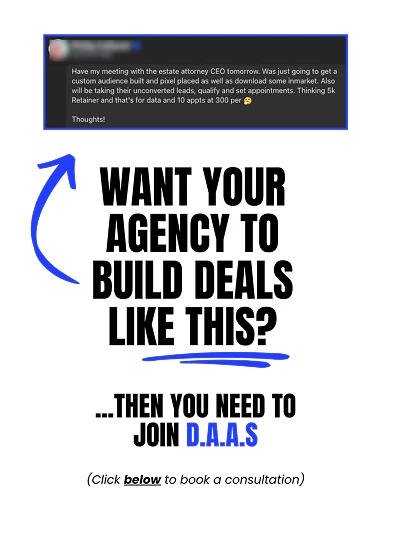
daas
For decades, agencies built their value around execution. Campaign setup, creative production, media buying, and optimization defined success. That approach worked when platforms offered granular targeting and stable performance. Today, agencies face a very different reality. Platforms control the data, costs continue to rise, and differentiation is harder than ever. This shift is driving agencies toward a new model centered on data ownership, not just service delivery.
Traditional agencies have always sold outcomes, but the way those outcomes are achieved has changed dramatically. In the past, access to targeting options and platform knowledge created leverage. Now those advantages are disappearing.
Agencies are seeing:
Reduced targeting options across major ad platforms
Increased competition for the same audiences
Higher acquisition costs with less predictable performance
More client pressure to prove value beyond execution
As a result, many agencies are asking a hard question. What do we actually own?
Execution used to be a competitive advantage. Today it is expected. Campaign setup, creative testing, and optimization are increasingly automated or standardized.
When execution becomes a commodity:
Pricing pressure increases
Clients compare agencies on cost instead of value
Retention becomes harder when results fluctuate
Agencies become interchangeable
Without ownership of assets, agencies are forced to continuously prove value through labour. This creates burnout and limits growth.
Data ownership changes the power dynamic. Instead of relying on platform-controlled targeting, agencies that own audience data create their own leverage.
Owning data allows agencies to:
Build reusable audience assets
Improve targeting accuracy across platforms
Reduce dependence on any single ad network
Offer clients something competitors cannot replicate
This is where Data as a Service becomes critical. It allows agencies to productize data and turn it into a scalable business asset rather than a byproduct of campaigns.
In a Data as a Service model, the agency’s core deliverable is not ads or creative. It is verified, enriched audience data.
That typically includes:
B2B or B2C audience segments built around real behaviour
Ongoing enrichment and validation to maintain accuracy
Automated delivery into ad platforms or CRM systems
Clear performance metrics like match rate and conversion impact
Instead of rebuilding targeting logic for every campaign, agencies deliver ready-to-activate data that clients can use repeatedly.
AudienceLab was designed to support this exact shift. Agencies use it to build, manage, and activate verified audiences while maintaining full control. You can explore the model here:
https://audiencelab.io/daas/
Clients are becoming more educated. Many no longer want an agency to simply run ads. They want better data, clearer targeting, and more transparency.
From a client’s perspective:
Poor targeting wastes budget
Platform audiences feel increasingly generic
Data quality matters more than creative volume
Faster testing requires better inputs
Agencies that provide data instead of just execution align better with these expectations. They enable clients to move faster and make smarter decisions.
Data ownership does not just improve performance. It fundamentally improves how agencies operate.
Agencies that adopt a data-centric model experience:
Fewer fulfilment bottlenecks
Less reliance on large teams
More predictable revenue streams
Easier onboarding of new clients
Better margins due to automation
Once data delivery is automated, the agency’s role shifts from constant execution to product management and growth.
Traditional agencies scale linearly. More clients require more people. More people increase costs. Profit growth stalls.
Data-driven agencies scale differently:
One audience asset supports multiple clients
Costs do not increase at the same rate as revenue
Value compounds as data improves over time
Growth becomes more predictable
This shift is why agencies that adopt Data as a Service often see profit margins increase dramatically without increasing workload.
Agencies using AudienceLab have successfully transitioned from service-heavy operations to data-driven models.
Results commonly include:
Significant reduction in manual fulfilment hours
Higher client retention due to proprietary data assets
Improved campaign performance from verified audiences
Ability to charge for access rather than time
One agency built a fully productized Data as a Service offer with minimal ongoing work. That example is detailed here:
https://audiencelab.io/use-cases/using-audiencelab-to-create-a-data-as-a-service-offer-with-zero-fulfilment/
Agencies that rely entirely on ad platforms are exposed to changes they cannot control. Targeting rules change. Costs increase. Features disappear.
Data ownership reduces that risk by creating an independent layer between the agency and the platform. Instead of reacting to platform changes, agencies control the inputs that drive performance.
This independence is becoming increasingly important as privacy regulations and platform consolidation continue.
The shift toward data ownership does not require a complete overhaul. Many agencies start by layering data products on top of existing services.
A practical approach:
Identify a niche or vertical with repeat demand
Build a verified audience for that niche
Offer the audience as an add-on or standalone product
Automate delivery and refresh cycles
Gradually reduce manual fulfilment
Over time, data revenue replaces service revenue and creates a more resilient business model.
For a deeper comparison between models, this resource is helpful:
https://audiencelab.io/resources/data-as-a-service-vs-traditional-agency-model-audiencelab/
Agencies that own data build businesses that last. They move away from constant execution and toward asset creation.
Long-term advantages include:
Higher business valuation due to owned assets
Easier expansion into new markets
Stronger positioning in sales conversations
Less dependency on individual team members
In a market where execution is increasingly automated, ownership becomes the differentiator.
The agency model is not disappearing. It is evolving. Agencies that continue to rely solely on execution will face tighter margins and increased competition. Agencies that embrace data ownership will unlock new levels of scale and stability.
Data as a Service is not about abandoning creativity or strategy. It is about building a foundation that supports both without sacrificing profit or control.
If you want to see how this model works in practice, explore the AudienceLab platform here:
https://audiencelab.io/daas/